
When you first lay eyes on an ikat pattern, you notice its feathered edges, as if it were a crisp design glimpsed underwater. That gentle blur is the fingerprint of one of the world's oldest and most labor-intensive textile traditions, and at Frankie Rose Fabrics, few things draw us in like a fabric that bears the mark of the human hand.
Explore our Handwoven Cotton Ikat Fabrics for Clothing.
What is ikat fabric?
Ikat isn't a fiber, and it isn't quite a weave, but rather a resist-dyeing technique and the cloth made from it. The yarns are tied and dyed before they're woven, so the pattern on the fabric emerges from the threads as they are woven. The result is a soft, feathered motif you can't get any other way.
The name comes from the Malay-Indonesian word mengikat, meaning "to tie" or "to bind." Because the design lives in the threads themselves, true ikat is patterned on both faces of the cloth. There is no wrong side or face
How do you pronounce ikat?
Ikat is pronounced EE-KAHT (rhymes with "peek at"), not "eye-cat." The word is of Indonesian-Malay origin and, depending on context, can mean to tie or bind, as well as the cord or knot itself.
How is ikat made?
Bundles of yarn are tightly wrapped in a planned pattern so the wrapped sections are physically blocked from absorbing dye. The yarns are dyed, then sometimes re-tied and dyed again in other colors. A multicolored design can take many rounds of binding, dyeing, and re-binding before a single thread reaches the loom. Only once all the dyeing is complete do the threads meet the loom.
This puts ikat in the same family as tie-dye, shibori, and batik, with one key difference: in those techniques the resist is applied to finished cloth, while in ikat it's applied to the bare yarns first.
Why do the patterns on ikat look a little blurry at the edges?
Those feathered, imprecise edges are the signature of true woven ikat. Once the dyed yarns are on the loom, the weaver has to line them up so the pattern resolves correctly, and the slight, unavoidable shifting of the threads during weaving creates the characteristic blurred edges. Finer yarns and a more skilled weaver can sharpen it, which is partly why crisper, more complex ikats command higher prices—but many makers and collectors prize the organic look. It's the fingerprint of a human hand, not a flaw.
What are the three types of ikat?
There are three, defined by which yarns carry the dyed pattern:
Warp Ikat
Only the lengthwise (warp) yarns are resist-dyed; the weft is solid. The pattern is visible on the loom before weaving begins, and the results are crisper and less feathery. This is the most common and most approachable type.
Weft Ikat
Only the crosswise (weft) yarns are dyed, and the pattern emerges only as weaving progresses. Because the weft isn't anchored like the warp, the weaver adjusts the yarns with nearly every pass, making it slower and a little more irregular.
Double Ikat
Both warp and weft are resist-dyed and aligned with each other as the cloth is woven, so the design builds from both thread systems at once. It's the rarest and most demanding. India's prized Patola saris and the geringsing cloths of Tenganan, Bali are double ikat.
What is ikat made of?
Silk and cotton are the most traditional and common fibers used in ikat, but you'll also find it in wool, rayon, and blends, too. Fiber is the single biggest factor in how a given ikat will feel, drape, and sew—so it matters more than the word "ikat" on the label.
Where did ikat originate?
Almost everywhere! Though the name we use is Indonesian, the technique developed independently across Southeast Asia, India, Central Asia, Japan, West Africa, and the Americas. Different regions have their own words for it: kasuri in Japan, atlas in Uzbekistan, and mat mii in Laos and Thailand.
The skill and time involved long made ikat a marker of wealth and status. Nineteenth-century Central Asian cities like Bukhara wove dazzling warp ikats, and in parts of Indonesia ikat is woven into the fabric of life quite literally—used for everything from infant garments to the funerary shrouds passed down as family heirlooms. India has an especially rich handloom tradition, where ikat sits alongside khadi as a vital part of the textile economy and a living link to craft that industrial production threatens to erase.
If the pattern looks familiar even though you've never sewn the real thing, you might have Oscar de la Renta to thank. He was so taken with ikat that he commissioned the fabric from Uzbeki weavers and used it in his collections for years, bringing the motif into the Western textile lexicon.
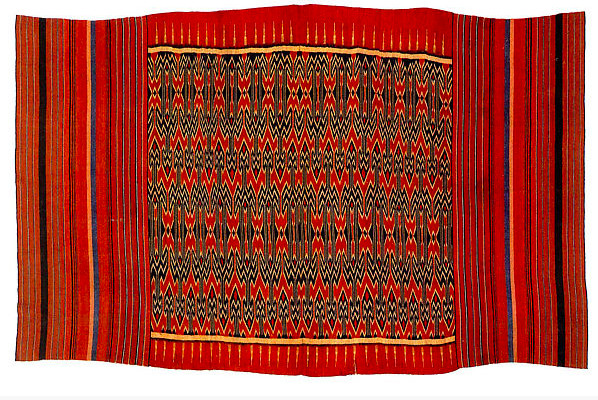
Ikat funerary Shroud from the late 19th century. The Metropolitan Museum of Art. Source: The Met

Ikat-inspired jacket designed by Oscar de la Renta for the spring/summer 1997 collection. From the Collection of Annette de la Renta. Source: Smithsonian Museum of Asian Art
What's the difference between woven ikat and "ikat print"?
Sometimes fabrics are sold with ikat-style motifs printed onto woven cloth rather than dyed into the yarn. Printed ikat can be pretty and more uniform, but it isn't true ikat. The print can fade over time in a way dyed-in-the-yarn color won't.
True ikat is easy to spot:
Flip it over. Real ikat shows the pattern on both sides. A print looks blank or faded on the wrong side.
Look for the feathered edges. Genuine ikat has soft, feathered pattern edges; a print has sharp ones.
Feel the texture. Handwoven ikat has a slightly coarse, subtly uneven surface, while printed cloth feels uniformly smooth.
What can I make with ikat?
It depends on the fiber and weight, but ikat shines in garments where the pattern can move and be seen:
Dresses
Skirts
Woven tops and button-ups
Lightweight pants and shorts
Statement jackets
Because both sides are patterned, ikat is wonderful for anything with cuffs, collars, or facings that might flip and show their reverse—no awkward white underside peeking out. There's also a long tradition of not forcing ikat into perfect symmetry across seams; letting the pattern fall where it may saves precious cloth and looks beautiful, so don't feel you have to fight the natural drift of the design.
Is ikat hard to sew with?
That depends on the fiber, not the ikat itself. A stable cotton ikat is easy to cut and sew, and very beginner-friendly. A fine silk ikat may be more slippery, like other silk or viscose challis. All true ikat is woven, so you'll need to finish your edges.
What needle and thread should I use for ikat?
Use a universal needle in sizes 70-90 for cotton ikat, or a microtex (sharp) needle for silk ikat. A high-quality 50-weight polyester thread is a strong, fade-resistant choice. If you plan to dye your finished garment, switch to a same-weight cotton thread so the thread takes the dye along with the fabric.
How do I wash and care for ikat?
Always prewash, and treat it gently. Many handwoven, naturally dyed ikats are happiest hand washed and may release a little color in the first few washes. As with any natural fiber, prewash and dry the same way you intend to care for the finished garment. In sum, best practice is to wash in cool water by hand or in a delicate cycle, hang to dry or tumble dry low, and press on the setting appropriate to the fiber.
Where can I buy high-quality ikat fabric for clothes?
Clothing benefits from finer cloth than craft or upholstery fabric, so apparel-focused fabric stores are your best bet for garment-weight ikat.
Why we love ikat fabric
For us, ikat is the ultimate expression of what makes handmade fabric special. It's slow where the world is fast, beautifully imperfect, and carried forward by artisans across dozens of cultures who turn plain yarn into something that can take months to complete. Every feathered edge is a record of a human hand at a loom—and we can't think of a better reason to keep coming back to it.
Learn more about ikat
Ikat — Fashion History Timeline, Fashion Institute of Technology: A well-sourced scholarly overview citing the Encyclopedia of Clothing and Fashion and the Berg Encyclopedia of World Dress and Fashion, with museum examples and the Oscar de la Renta story.
Irresistible: The Global Patterns of Ikat from The Textile Museum at George Washington University: An exhibition spanning ikat traditions across India, Asia, Central Asia, Japan, Africa, and the Americas.
The Fabric of Life: Ikat Textiles of Indonesia from The Metropolitan Museum of Art: Museum holdings of Indonesian ikat, including ceremonial shrouds.
To Dye For: Ikats from Central Asia from the Smithsonian's National Museum of Asian Art: The beautiful warp ikats of nineteenth-century Central Asia.
What is Ikat? from The Craft Atlas: A clear, technique-focused explanation of warp, weft, and double ikat.